

API Pipeline
Overview
API Pipeline is a visual workflow engine that supports freely combining multiple model APIs (such as text dialogue, image generation, audio processing, etc.) through nodes to build automated task flows. It can quickly connect the input and output of different models, intelligently handle parameter conversion, and reduce the complexity of multi-model collaboration. Its advantages lie in out-of-the-box AI capability integration, low-code interactive design, and flexible adaptation to complex business scenarios, significantly improving development efficiency.
Quick Start
If you are using API Pipeline for the first time, it is recommended to read in the following order:
- Quick Start - Get started quickly with practical examples
- Node Description - Understand the functions and configurations of various nodes
- Application Scenarios - Explore practical applications of different models
Key Concepts
Node Types
An API Pipeline consists of nodes with different functions, and each node performs specific operations:
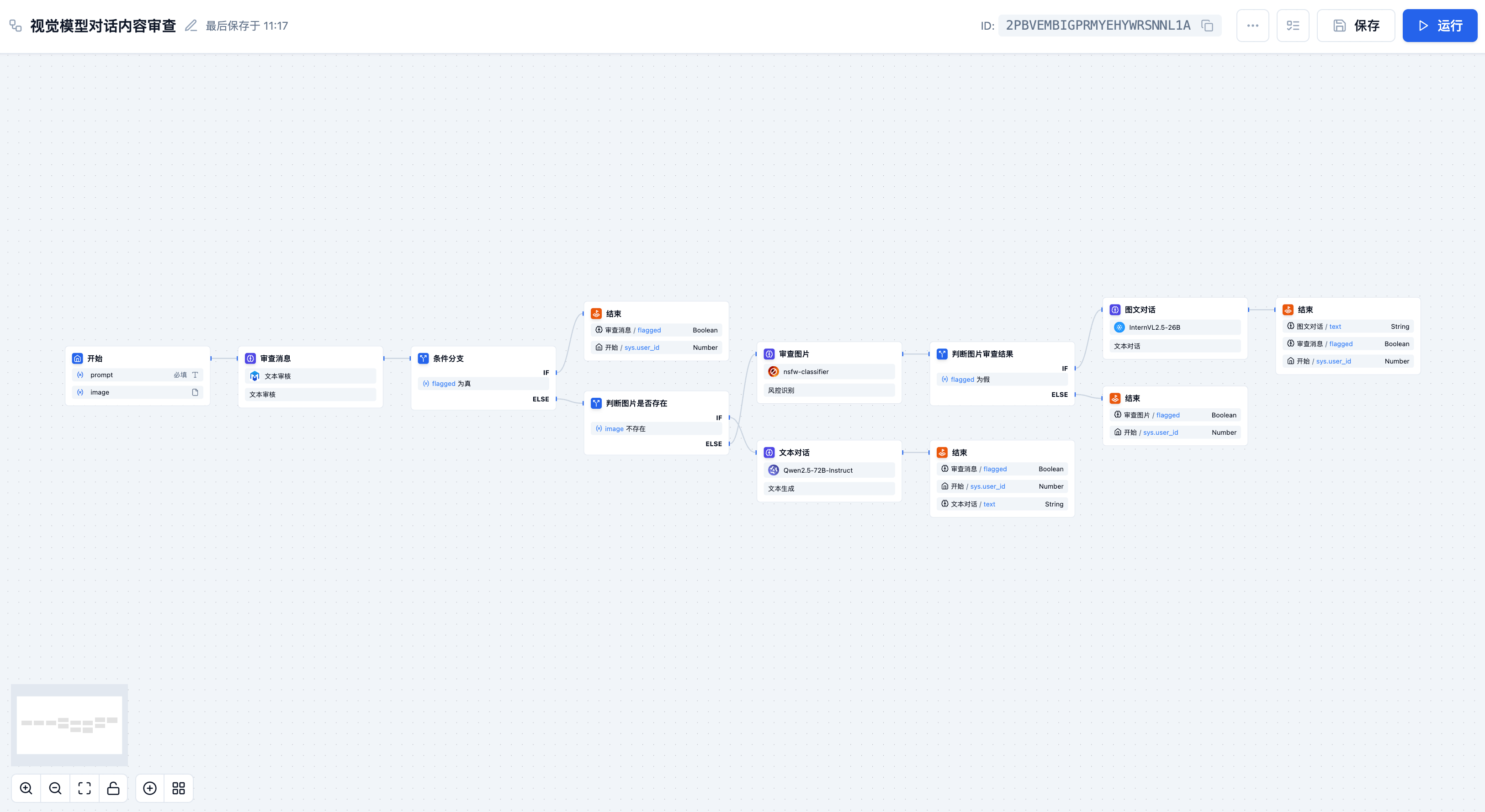
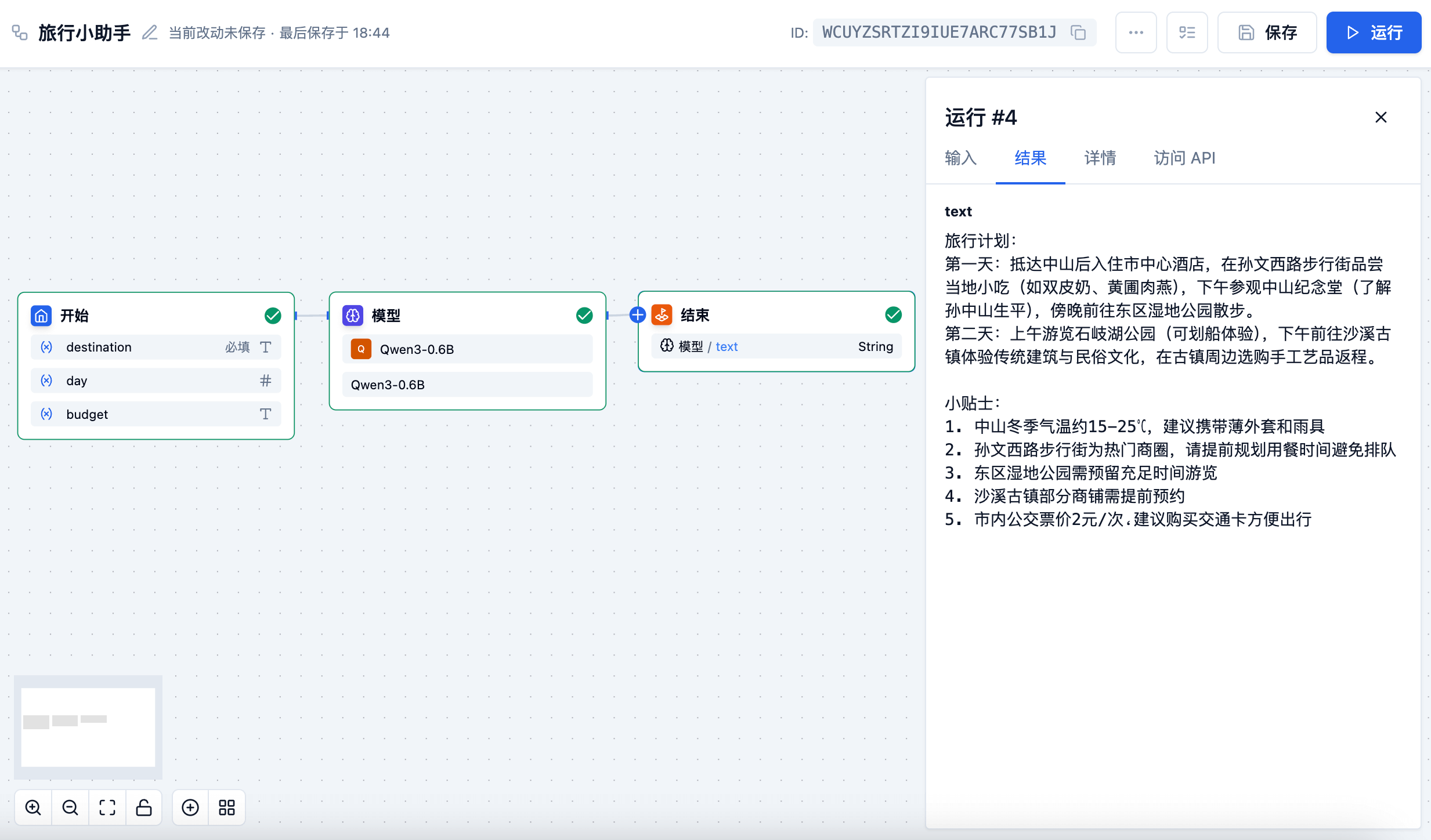
- Start Node - The entry point of the API Pipeline, defining input parameters
- Model Node - Calls AI models to process data
- Conditional Branch Node - Selects execution paths based on conditions
- Comment Node - Adds comment explanations to the pipeline
- End Node - The exit point of the API Pipeline, defining output results
Variable System
Variables are used to connect the input and output of preceding and subsequent nodes in the API Pipeline, enabling complex processing logic in the flow:
- System variables: Variables automatically generated and managed by the system
- Node variables: Output variables generated by each node
Execution Flow
The API Pipeline executes in the order of node connections:
- Obtains input parameters from the start node
- Executes each node in sequence according to the connection order
- Implements different execution paths through conditional branches
- Outputs the final result at the end node
Supported Model Types
API Pipeline supports various types of AI models to meet different business needs:
| Model Type | Main Functions | Application Scenarios |
|---|---|---|
| Text Generation | Text understanding, generation, classification | Content creation, customer service Q&A, translation |
| Vision Models | Image understanding, content recognition | Image analysis, OCR, quality inspection |
| Image Generation | Generate images from descriptions | Design creation, content production |
| Speech Models | Speech recognition, speech synthesis | Voice assistants, content broadcasting |
| Risk Control Recognition | Risk identification, content review | Risk management, content security |
Billing Model
The cost of API Pipeline is calculated based on model calls, depending on the type and number of model nodes. Billing is directly related to the resource package permissions bound to your access token.
Different resource packages may contain different available models and corresponding prices. To ensure that your API Pipeline has full call permissions for all models, it is strongly recommended to purchase the Full Model Resource Package and use the access token bound to this resource package for calls.
Billing Rules
- Each call to a model node incurs a fee
- Different types of model nodes have different fees
- Total cost = Sum of call fees for all model nodes
Example
Suppose an API Pipeline includes:
- 1 text generation model node (¥0.02/call)
- 1 image generation model node (¥0.05/call)
Then the cost for each call of this API Pipeline is: ¥0.02 + ¥0.05 = ¥0.07
For the specific cost of each model, please refer to the Model Plaza
Next Steps
Ready to start using API Pipeline?
👉 View Operation Steps to learn how to create your first API Pipeline
👉 Browse Application Scenarios to find solutions suitable for your business
 京公网安备11011502039387号